
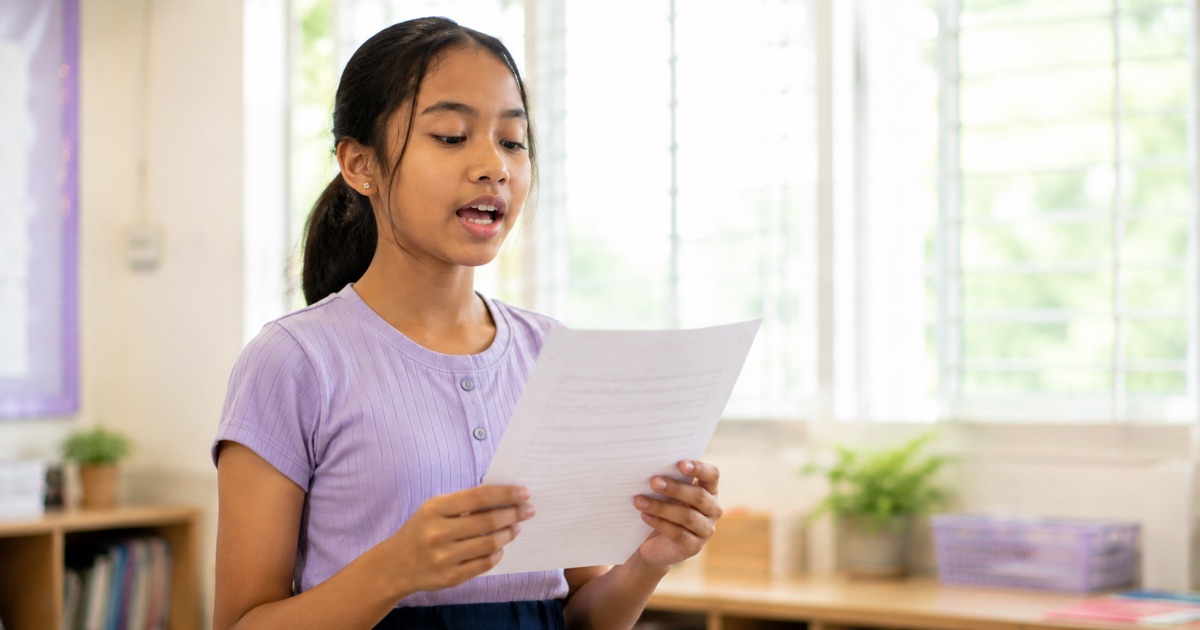
PSLE Reading Aloud 2026: how to score full marks

If the Stimulus-Based Conversation is where children get nervous, Reading Aloud is where they should get marks, because unlike a conversation, the words are right there on the page. Nothing to invent, nothing to remember. And yet many children leave marks behind through rushing, flat delivery, or missing the tone the passage is asking for.
Here's how your child can read for full marks.
What examiners are actually listening for
Reading Aloud isn't a speed test or a "no mistakes" test. Assessors reward reading that is:
- Clear. Words pronounced correctly and distinctly, including the tricky ones.
- Well-paced. Not racing, not crawling; natural speaking speed with pauses at punctuation.
- Expressive. The voice rises and falls with the meaning, rather than droning in a flat line.
- Right for the situation. This is the piece most children miss (see below).
The one thing most children miss: the situation line
In the current format, the passage has a short line at the top that sets the scene: who is speaking, to whom, and why. It might tell your child they are, say, an excited student telling a friend about a school trip, or a helpful guide giving directions to a visitor.
That line is an instruction, not decoration. It tells your child what tone to read in. An excited message should sound excited; a set of instructions should sound clear and calm. Reading the same passage in a flat, one-note voice, however accurately, leaves expression marks on the table.
Teach your child to do this first: before reading a single word aloud, read the situation line silently and ask, "Who am I, and how would this person sound?"
The mistakes that quietly cost marks
- Rushing. Nerves make children speed up. Faster reading means slurred words and no expression. Slower is almost always better.
- Ignoring punctuation. A full stop is a pause; a comma is a short breath; an exclamation mark is energy. Punctuation is a built-in map for how to read.
- Flat delivery. Reading every sentence in the same tone, regardless of meaning.
- Mumbling the hard word. Guessing quietly and moving on. Better to slow down and pronounce it clearly.
- No warm-up. Cold-reading a passage they've never seen, at speed, is the worst-case scenario, which is exactly why home practice matters.
How to practise at home (10 minutes a day)
- One paragraph, out loud, every day. Any storybook, news article, or even a cereal box. The goal is comfort with reading aloud, so nerves don't spike on exam day.
- You read it first. Model the expression, let them hear a full stop become a pause and an exclamation become energy. Then they copy, then they improve.
- Play "what's the situation?" Before reading a passage, decide together who's speaking and how they'd sound. Read it that way.
- Record and replay. Let your child hear themselves on your phone. They'll notice rushing and flatness faster than any correction from you.
- Hunt the hard words. Skim for names and unfamiliar words first, practise those, then read the whole passage smoothly.
Practise with real passages
Our free PSLE Reading Aloud practice passages are written in the current 2026 style, each with a situation line and notes on the tone to aim for, plus pronunciation tips for the tricky words. Print one a day for the countdown to 12 August.
The mindset to send them in with
Reading Aloud is the part of the Oral your child can most control. The words are given. The job is simply to read them clearly, at a calm pace, with expression that fits the situation. A child who has read one paragraph aloud every evening for three weeks will walk in and do exactly that.
Free, teacher-written practice from the team behind Zippy: AI-assisted feedback on student writing and speaking, built for teachers and tutors. Try the live grader →
Related: PSLE Oral 2026: Complete Parent's Guide · How to Answer the SBC Photo