
O-Level Visual Text Practice 2: The Museum Exhibition Flyer
This practice uses an original exhibition flyer written for this page. It follows the style of Paper 2, but it does not come from any past paper. Flyers mix big promises with small conditions, so read every line. Open each answer only after you have chosen your own.
The flyer
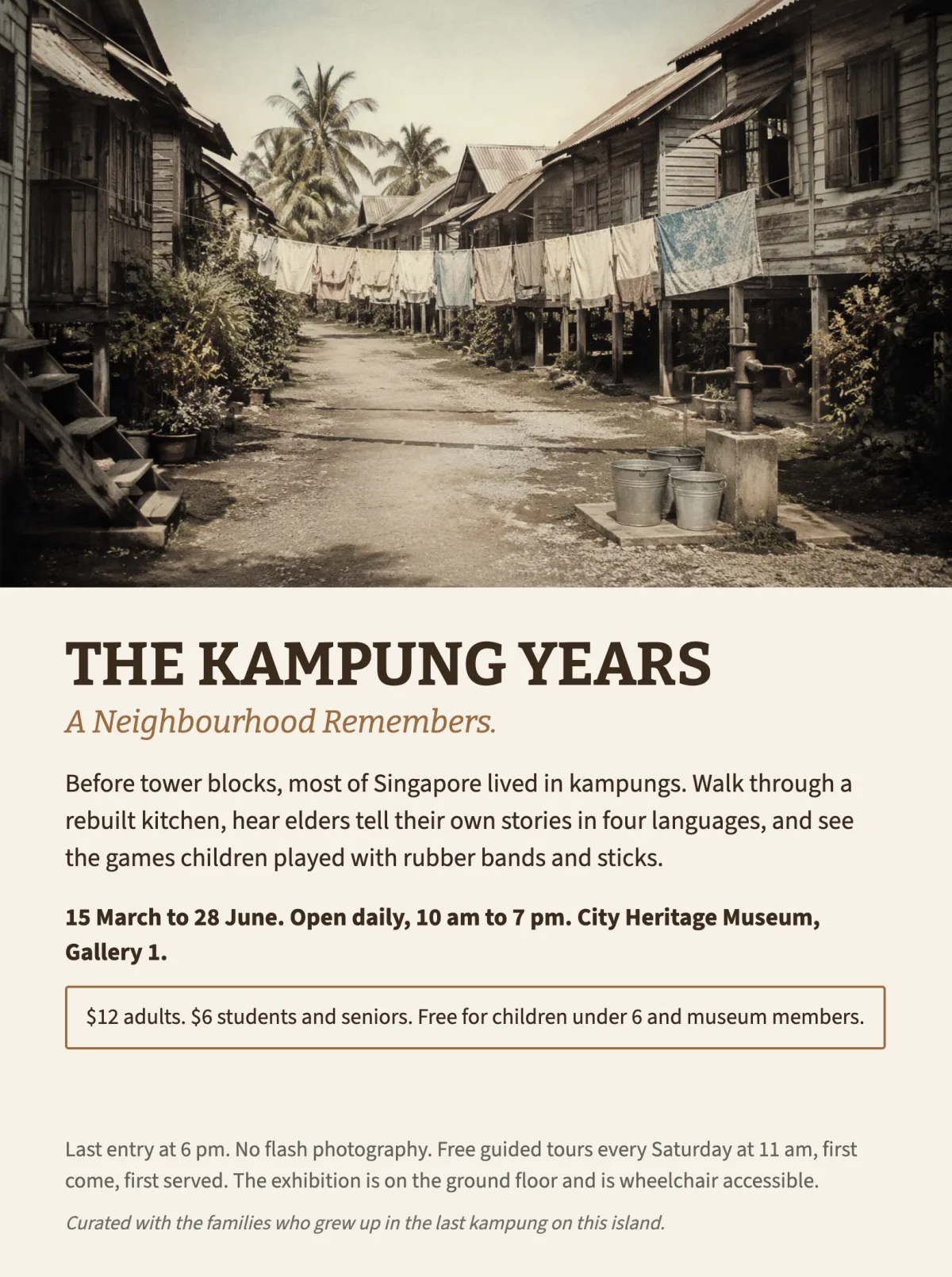
A restored photograph from the 1960s, hand-tinted in soft colour, fills the top half. It shows a narrow kampung lane between wooden houses, with laundry strung on lines between them and a communal water tap at the roadside.
Text version of the flyer
THE KAMPUNG YEARS: A Neighbourhood Remembers.
Before tower blocks, most of Singapore lived in kampungs. Walk through a rebuilt kitchen, hear elders tell their own stories in four languages, and see the games children played with rubber bands and sticks.
In bold: 15 March to 28 June. Open daily, 10 am to 7 pm. City Heritage Museum, Gallery 1.
In the price box: $12 adults. $6 students and seniors. Free for children under 6 and museum members.
In small print along the bottom: Last entry at 6 pm. No flash photography. Free guided tours every Saturday at 11 am, first come, first served. The exhibition is on the ground floor and is wheelchair accessible.
In the corner: Curated with the families who grew up in the last kampung on this island.
The questions
What is the MAIN purpose of this flyer?
Show answer & explanation
Answer: (B) To attract visitors to an exhibition about kampung life
The correct answer is (B). The flyer lists dates, prices and tours in the style of an invitation. Every line works to bring visitors through the door.
Who is the main target audience, and which detail shows it?
Show answer & explanation
Answer: (B) The general public, including students and older visitors, because the prices list students and seniors and the stories are offered in four languages
The correct answer is (B). '$6 students and seniors' prices two wide groups. The stories 'in four languages' promise access across generations and communities.
The photograph is hand-tinted in soft colour and shows laundry lines strung between the houses. How does this picture work with the line 'Walk through a rebuilt kitchen'?
Show answer & explanation
Answer: (A) Both promise a close-up walk into ordinary life, so visitors expect to meet the past at eye level
The correct answer is (A). The tinted scene and the rebuilt kitchen offer small, ordinary details of daily life. Both invite visitors to step into the past rather than view it behind glass.
Which statement is TRUE according to the small print and price box?
Show answer & explanation
Answer: (D) A Saturday tour may fill up, so arriving early matters
The correct answer is (D). The words 'first come, first served' warn that tour places can run out. The free item on Saturdays is the tour, last entry is 6 pm, and members enter free.
The flyer ends, 'Curated with the families who grew up in the last kampung on this island.' What does this line suggest?
Show answer & explanation
Answer: (B) The exhibition is built on their own memories, so it shows kampung life from the inside
The correct answer is (B). 'Curated with' makes those families the source of the stories. It promises first-hand memory rather than a distant museum account.
One thing to carry away
An audience answer needs a named group and evidence. 'Everyone' scores nothing, because it points at no line. Find the price, the age or the language detail that decides the group.
Back to O-Level visual text · Next: Practice 3