
O-Level Visual Text Practice 3: The Sports Camp Web Page
This practice uses an original web page, typed out for you. It follows the style of Paper 2, but it does not come from any past paper. Screens invite skimming, so read every part of it twice. Open each answer only after you have chosen your own.
The web page
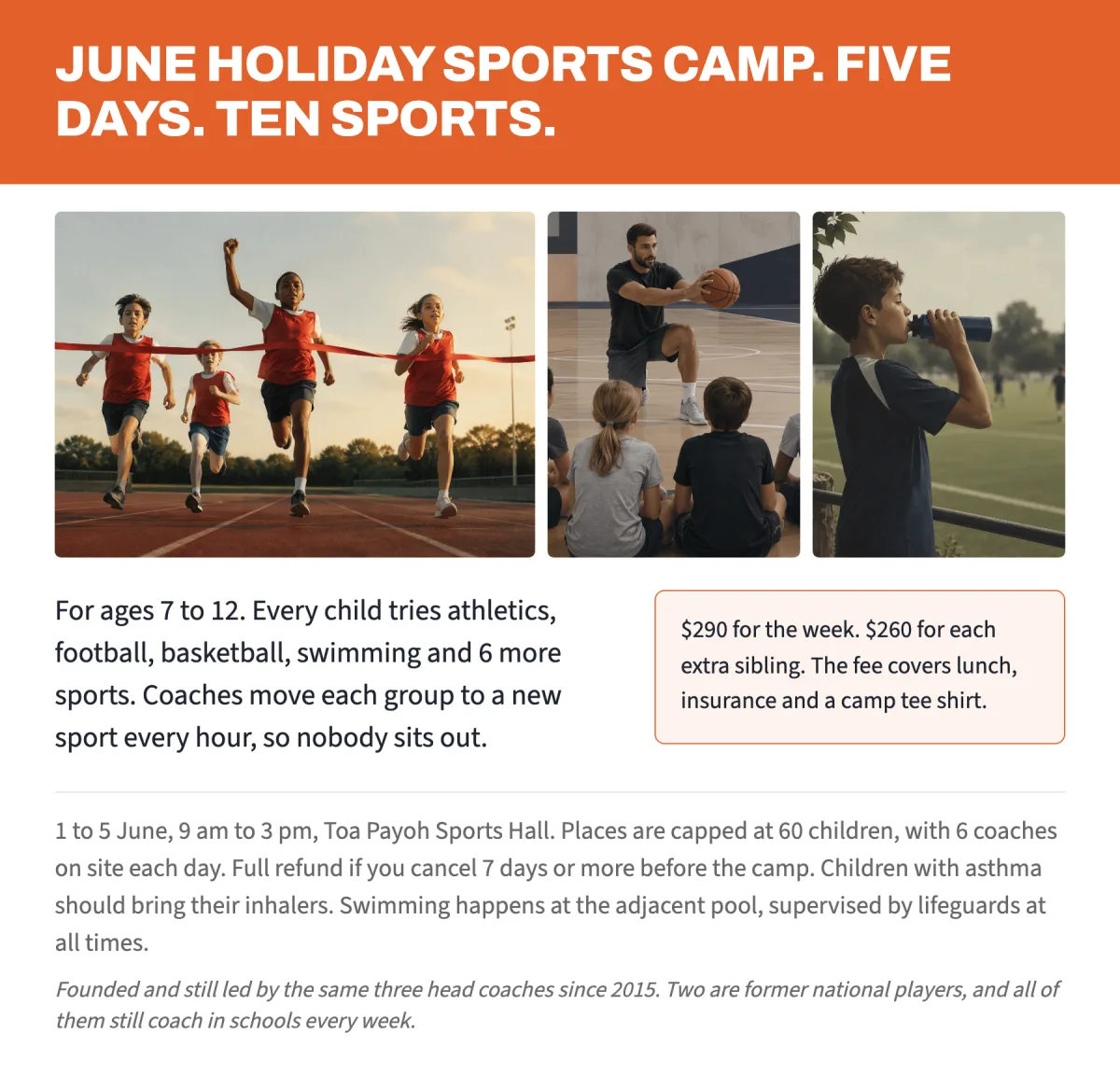
Three pictures sit in a row below the banner. In the widest, children in red kit reach a finish tape, the leader with a fist in the air. The second shows a coach demonstrating a basketball pass to a hushed circle of children. The third shows a child pausing to drink from a water bottle.
Text version of the web page
JUNE HOLIDAY SPORTS CAMP. FIVE DAYS. TEN SPORTS.
For ages 7 to 12. Every child tries athletics, football, basketball, swimming and 6 more sports. Coaches move each group to a new sport every hour, so nobody sits out.
In the price box to the right: $290 for the week. $260 for each extra sibling. The fee covers lunch, insurance and a camp tee shirt.
In small print along the bottom: 1 to 5 June, 9 am to 3 pm, Toa Payoh Sports Hall. Places are capped at 60 children, with 6 coaches on site each day. Full refund if you cancel 7 days or more before the camp. Children with asthma should bring their inhalers. Swimming happens at the adjacent pool, supervised by lifeguards at all times.
The closing line: Founded and still led by the same three head coaches since 2015. Two are former national players, and all of them still coach in schools every week.
The questions
What is the MAIN purpose of this web page?
Show answer & explanation
Answer: (B) To persuade parents to sign their children up for the camp
The correct answer is (B). The page prices the week, caps the places and sets a refund policy. That is the machinery of a sign-up pitch.
Who is the main target audience, and which detail shows it?
Show answer & explanation
Answer: (C) Parents of primary school children, because the page names ages 7 to 12 and prices 'each extra sibling'
The correct answer is (C). 'For ages 7 to 12' fixes the child's age. The phrase 'each extra sibling' speaks to the person paying the fees.
The widest photo shows children in red kit reaching a finish tape, the leader with a fist in the air. How does this picture work with the promise 'so nobody sits out'?
Show answer & explanation
Answer: (B) It backs the promise, because the picture puts a whole crowd of children inside the action rather than on the sideline
The correct answer is (B). The picture shows a whole crowd of children mid-race. It makes the words 'so nobody sits out' look like a promise already kept.
Which statement is TRUE according to the small print?
Show answer & explanation
Answer: (D) Lifeguards watch the swimming at all times
The correct answer is (D). The small print says the pool is 'supervised by lifeguards at all times'. Refunds need 7 days' notice, lunch is included, and the cap is 60 children.
The page closes, 'Founded and still led by the same three head coaches since 2015. Two are former national players, and all of them still coach in schools every week.' What does this line suggest?
Show answer & explanation
Answer: (D) The organisers want parents to trust the coaching, so they point to years of experience and current practice
The correct answer is (D). The words 'since 2015' offer years of experience. The phrase 'still coach in schools every week' offers current skill, so the line builds trust.
One thing to carry away
The small print decides the trickiest questions in a paper like this. Read every line of the conditions, even the dull ones. A statement is only true when the page actually says it.
Back to O-Level visual text · Back to all free lessons