
PSLE SBC Practice 5: Helping an Elderly Neighbour (model answers)
How to use this page: cover the model answers, respond to each question out loud, then compare. The examiner notes explain where the marks are.
The stimulus
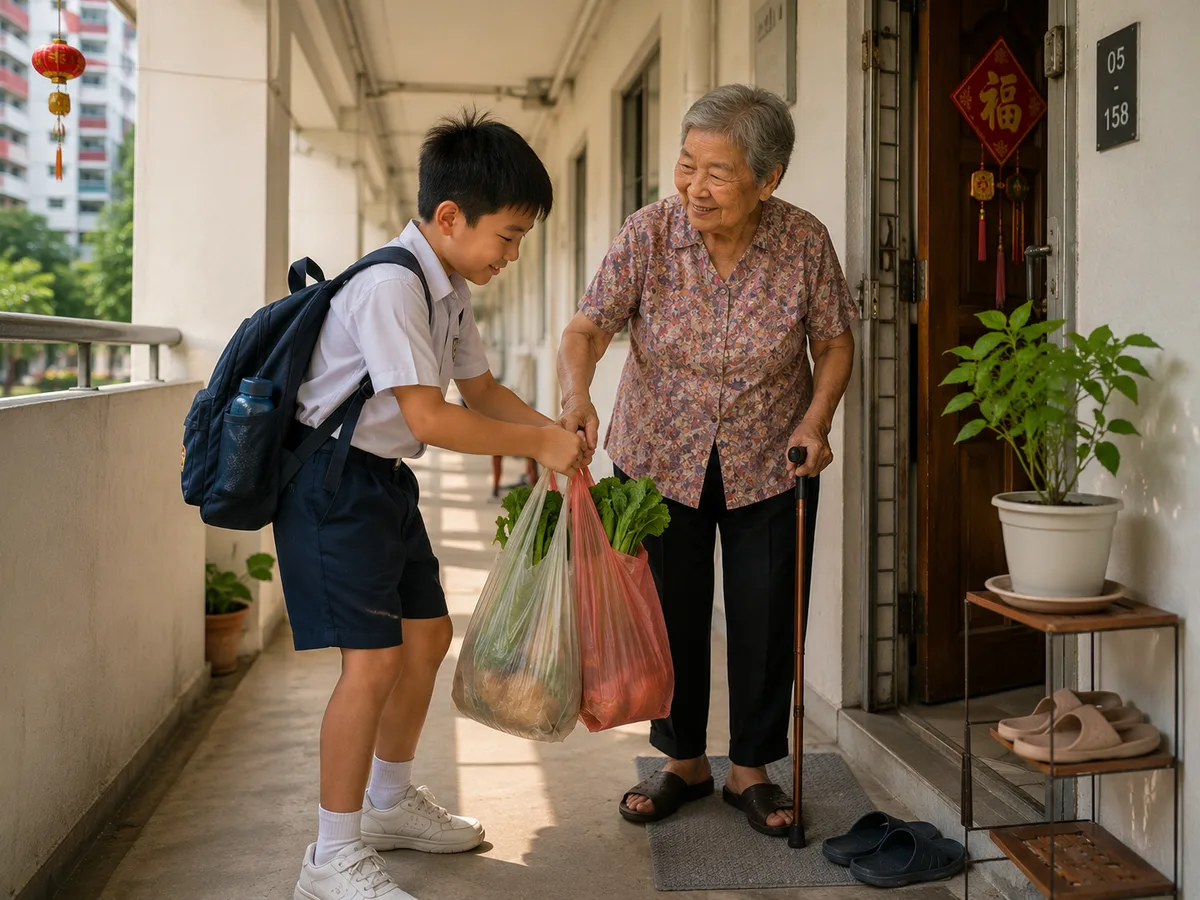
In the corridor of an HDB flat, a young boy is helping an elderly woman carry her groceries. She holds a walking stick in one hand and smiles gratefully as the boy lifts two heavy bags. A small potted plant and a pair of slippers sit outside her door. The boy's own school bag is still on his back, as if he has stopped on his way home.
In the real exam the stimulus is a photograph; this image stands in for one. Describe it as if you can see it.
Question 1, "Look at the people in the picture. How do you think they are feeling? Why do you say so?"
The 2026 first question is picture-based and asks you to read the people's feelings and back it up with what you can see, not just list objects. Name the feeling, then point to the evidence.
Weak answer: "The lady feels happy. The boy is helping her."
Strong answer: "I think the elderly woman is feeling grateful and relieved, because she is smiling warmly at the boy as he lifts her two heavy bags, and with her walking stick she would have found them hard to carry alone. The boy seems kind and willing to help, since he still has his school bag on his back, so it looks like he stopped on his way home rather than being asked. He appears happy to help her, not reluctant, which is why the moment looks so warm."
Examiner note: the weak answer names a feeling with no support. The strong answer reads both people's feelings, grateful and relieved (the woman) and kind and willing (the boy), and justifies each with evidence ("smiling warmly", "walking stick", "still has his school bag on his back"). Noticing how each person feels, backed by detail, is exactly what the 2026 picture question rewards. Formula: "They feel ___ because I can see ___."
Question 2, "Have you ever helped someone older than you? Tell me about it."
The mark is for a developed personal response, a real example, described with some detail.
Weak answer: "Yes, I helped my grandfather once. It was nice."
Strong answer: "Yes, I have. My grandfather's eyesight is not very good, so I often help him read his letters and messages aloud. One evening, I helped him fill in a form he had received because the words were too small for him to see. He kept thanking me and said I was a great help. It made me happy because it was something small for me, but it really mattered to him. Now I try to check on him whenever I visit."
Examiner note: the weak answer is vague and stops early. The strong answer names a specific person and task, explains what the child did, and reflects on how it felt. Specific and personal beats general every time.
Question 3, "Do you think young people today care enough about the elderly? Why?"
A broader opinion question. The mark is for a clear, reasoned view, and it's fine to weigh both sides.
Strong answer: "I think many young people do care, though we could all do more. On one hand, I often see students giving up their seats on the MRT or helping neighbours, like the boy in the picture. On the other hand, everyone is busy with school and phones, so sometimes we forget to notice when someone needs help. So I believe most young people are kind at heart, but we should make more of an effort to slow down and look out for the elderly around us."
Examiner note: the answer takes a position, supports it with reasons, considers both sides, and links back to the stimulus (the helpful boy). That balance and development is what separates a top oral answer from a plain "yes, they care."
Practise the skill, not the script
These are models, not scripts to memorise. Rehearse the habits, describe the photo in full, and give every opinion a reason and a real example, on new photos each day. That flexibility is what the exam actually rewards.
Back to PSLE Oral Practice · Full method: How to Answer Any SBC Photo
Free practice from the team behind Zippy. Try the live grader →