
Progress
A mark tells a child how one piece went. Progress is the question underneath it: am I getting better, and at what?
What a student sees
Progress in the student portal opens on their own picture: an overall band, how much of their assigned work is done, how many skills have been assessed, and the single skill to work on next.
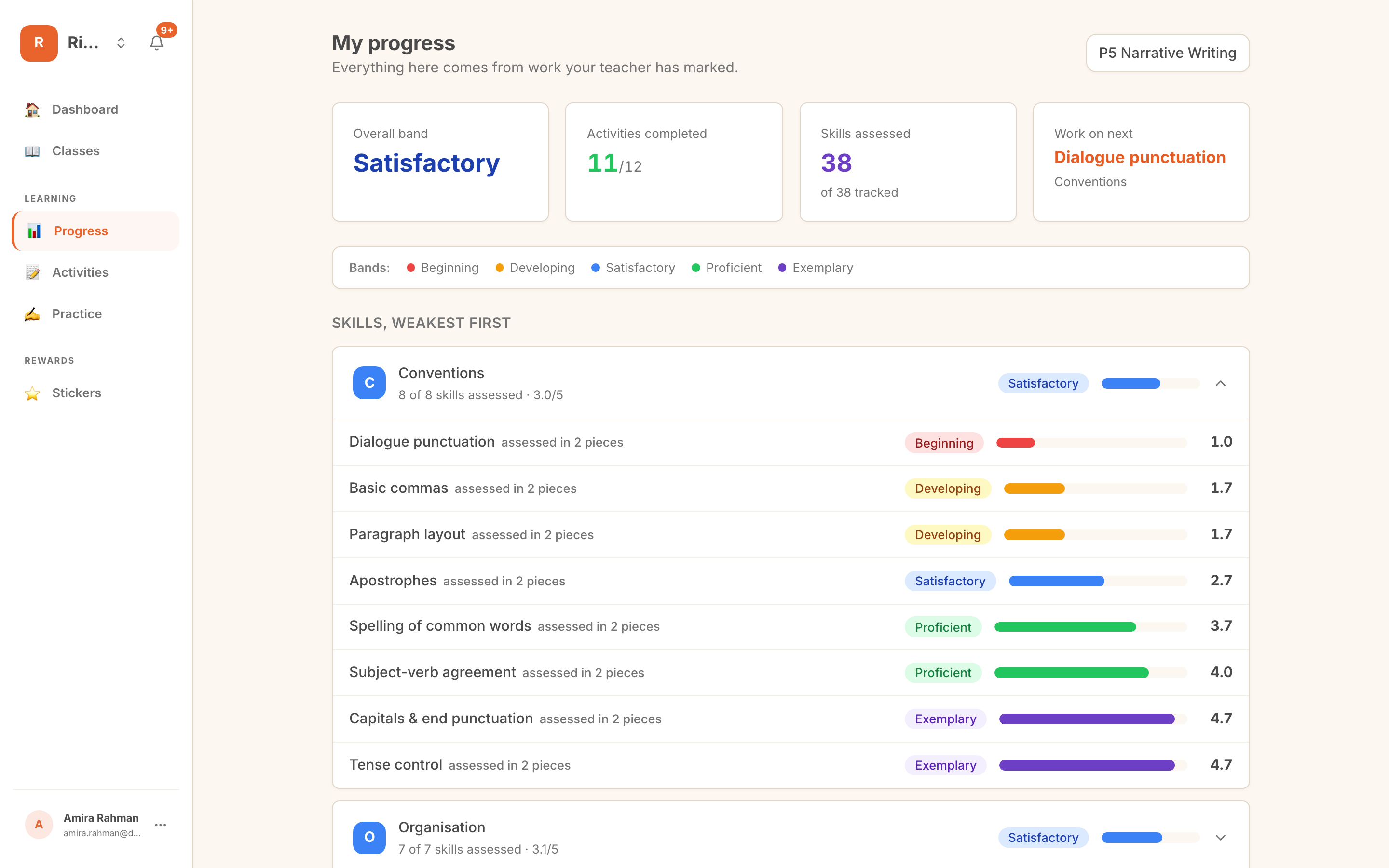 A student's own progress: overall band, skills grouped by trait, weakest first.
Below the numbers, every skill their marked work has assessed is grouped under its trait and ordered weakest first, with the weakest group already open. That ordering is the whole design. A child scrolling an alphabetical list learns nothing; a child who opens this page and reads Dialogue punctuation, Beginning, 1.0 at the top knows exactly what tomorrow is for.
Each skill carries the band, a bar, and the level out of five. They always agree with each other, and with the legend above them.
Where the levels come from
Nothing here is predicted, and nothing is inferred from effort. A level appears against a skill when a piece of marked work assessed that skill, using the same rubric the teacher set.
Each row says how much evidence is behind it — assessed in 2 pieces — because one marked piece and five are not the same claim.
That also means a skill nobody has been assessed on yet simply is not listed. An absent skill means no evidence, not a bad result.
Progress is built from the activities in the class, so it works whether or not you have imported a course. If you have, the By Unit tab additionally breaks the same evidence down by unit; without one, that tab is not shown.
Rewards, and what they are for
Streaks and stickers exist to get a child to come back and finish the next piece. They are motivation, not measurement.
They deliberately do not affect marks. A child cannot earn their way to a better score, and a teacher reading the gradebook is not seeing effort points mixed into attainment.
The teacher's version of the same question
You see the same skill picture per student, plus the activity feed behind it, on the student's Progress tab in your class.
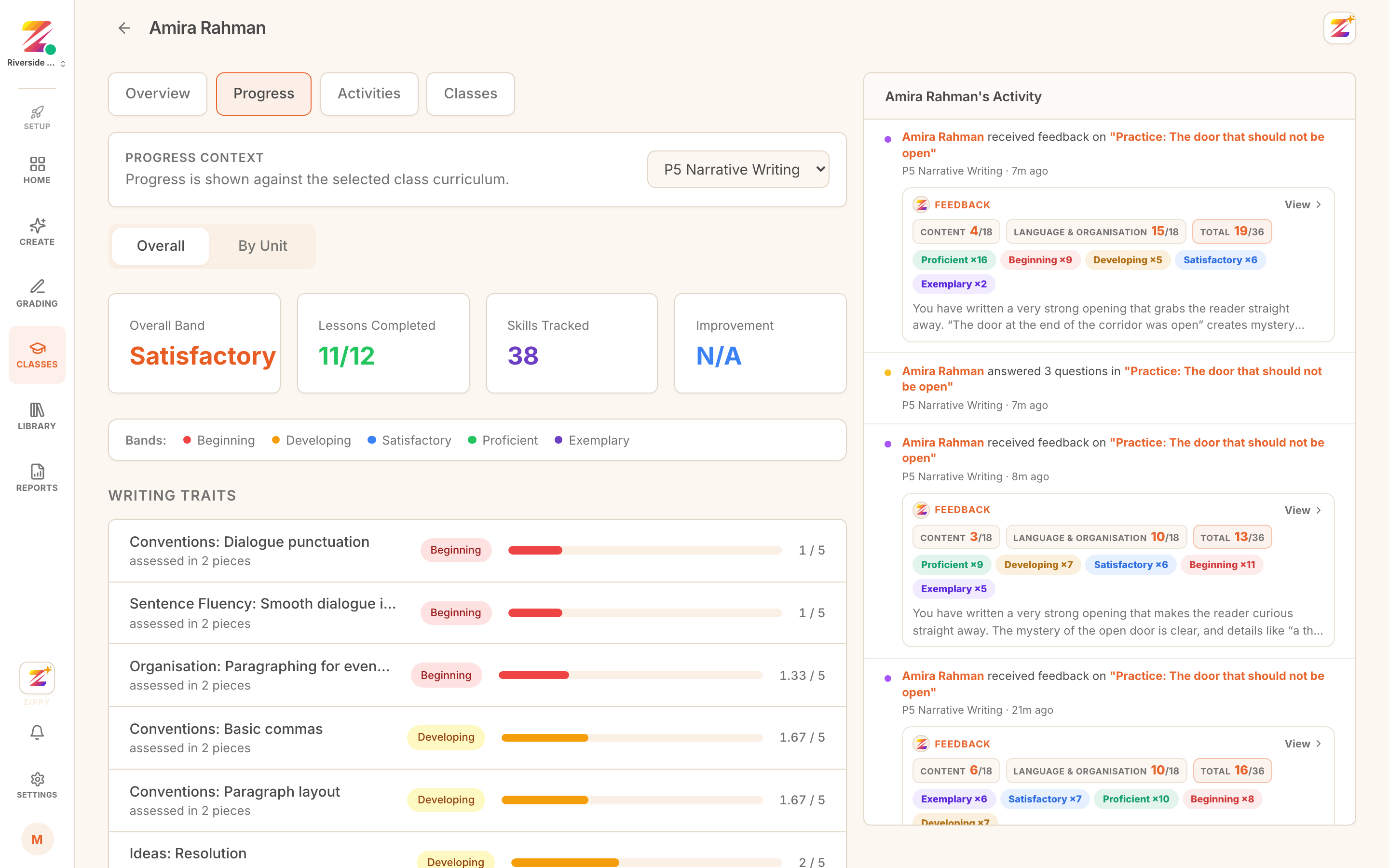 The teacher's view of one student's skills, banded and ordered weakest first.
For the class-wide version, including who is slipping and which skills are costing marks across the whole roster, see Reading your gradebook.
An honest note
Everything here is derived from work that has been marked. Nothing is predicted, and no claim is made about where a child will end up.
Where to go next
- AI teachers for how a student gets help with the skill they are stuck on.
- What students see.
- Reading your gradebook for the teacher-side view.