
PSLE Situational Writing 2: The Fun Run
Another informal email, and this time you are inviting rather than persuading. One complete task, with a model at the end.
The situation
Daniel and a neighbour read a notice taped up in their lift lobby.
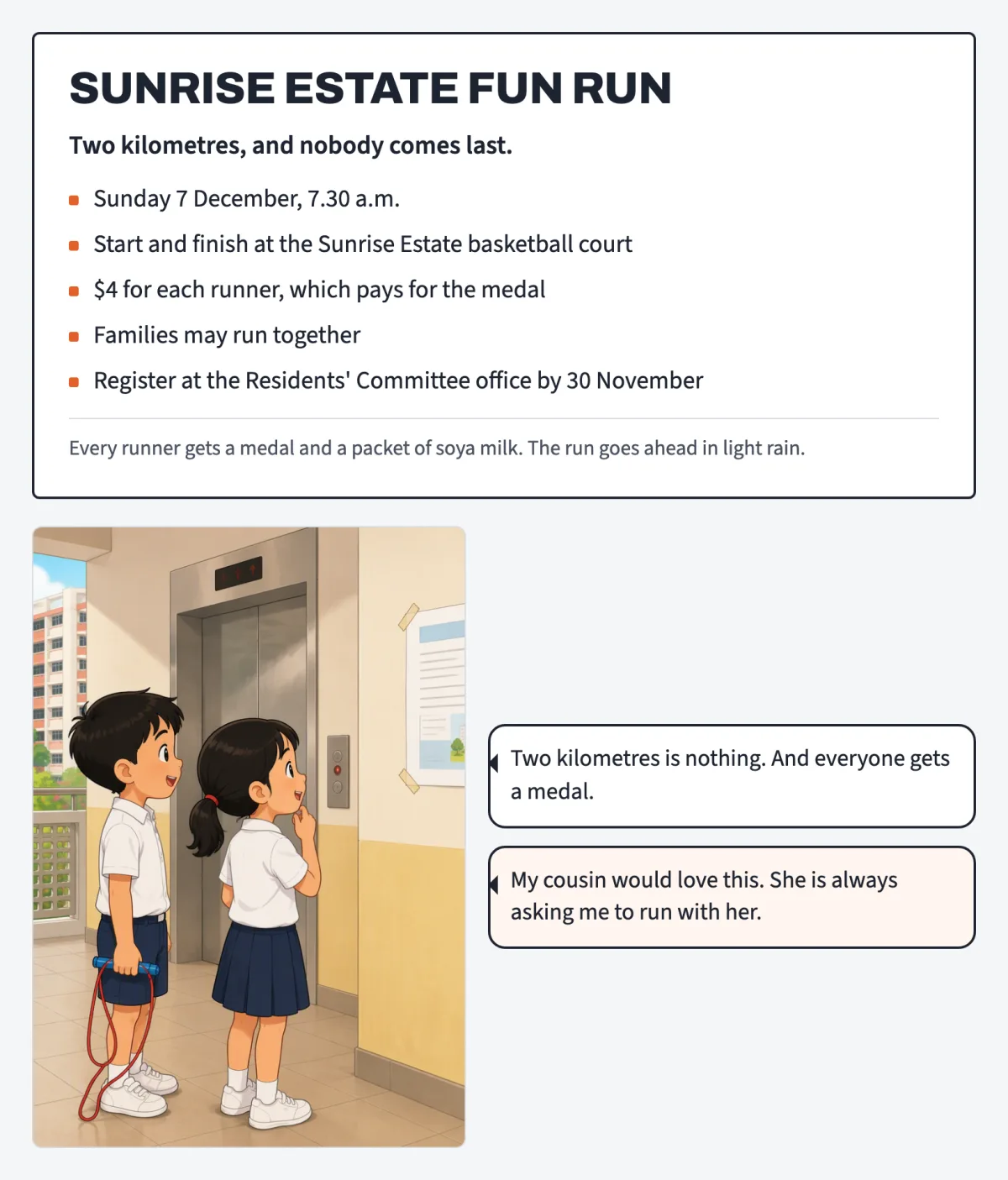
Visual source: the notice holds every fact. The pupils tell you why it matters to Daniel.
Text version of the notice
Sunrise Estate Fun Run
Two kilometres, and nobody comes last.
- Sunday 7 December, 7.30 a.m.
- Start and finish at the Sunrise Estate basketball court
- $4 for each runner, which pays for the medal
- Families may run together
- Register at the Residents' Committee office by 30 November
Every runner gets a medal and a packet of soya milk. The run goes ahead in light rain.
The two pupils are saying:
- "Two kilometres is nothing. And everyone gets a medal."
- "My cousin would love this. She is always asking me to run with her."
Your task
Imagine you are Daniel. Write an email to your cousin Priya, who lives in another estate, inviting her to run with you.
Your email must include:
- what the event is, and when and where it starts
- what it costs, and what she gets for it
- one reason you think she will enjoy it
- the date she must register by, and where
- a close that asks her to tell you if she is coming
Check your plan
Priya lives in another estate. Which sentence is most useful to her?
Show answer & explanation
Answer: (B) We start and finish at the Sunrise Estate basketball court at 7.30 a.m. on Sunday 7 December.
The correct answer is (B). Priya does not live here, so she needs the place as well as the time. (A), (C) and (D) are all true and all worth including, but someone travelling in cannot act on them. When a reader is coming from outside, she needs the place as much as she needs the time.
Which close does the most work?
Show answer & explanation
Answer: (C) Tell me by this weekend if you are coming, and I will register us both together.
The correct answer is (C). It asks for a reply, gives her a date, and offers to do something. (A) and (D) are formal sign-offs for a stranger, which is the wrong register for a cousin. (B) closes without asking for anything. A close should leave the reader with a next step.
Write your email
✍️ Your turn
Write Daniel's email to Priya. Cover all five points in the list above. Keep it warm, and take the date, the time, the place, the fee and the deadline straight from the notice.
The model
Open the model email
To: [email protected] Subject: Run with me on 7 December?
Hi Priya,
You keep telling me to go running with you, so here is your chance. Our estate is holding the Sunrise Estate Fun Run on Sunday 7 December at 7.30 a.m. We start and finish at the Sunrise Estate basketball court.
It is two kilometres, which is nothing for you, and it costs $4 each. That pays for the medal, and every runner also gets a packet of soya milk at the end. Families are allowed to run together, so we can stay side by side the whole way.
I think you will like it because nobody comes last. It is not a race against anybody.
If you want to come, we have to register at the Residents' Committee office by 30 November. Tell me by this weekend and I will go down and put both our names in.
From, Daniel
Why this scores
| What the model does | Why it works |
|---|---|
| Opens by referring to something between them | The tone suits a cousin |
| Gives the date, time and place together | Priya is travelling in, so she needs all three |
| Says the fee and what it pays for | Two facts she needs, in one sentence |
| Opens on something only she would recognise | "You keep telling me to go running with you" could not be written to anyone else |
| Names the deadline and offers to register them both | The reader knows exactly what happens next |
Your reasons can be different from the model's. What cannot change is the set of facts: 7 December, 7.30 a.m., the basketball court, $4, and 30 November.
Back to PSLE situational writing · Next: Practice 3: The Science Fair